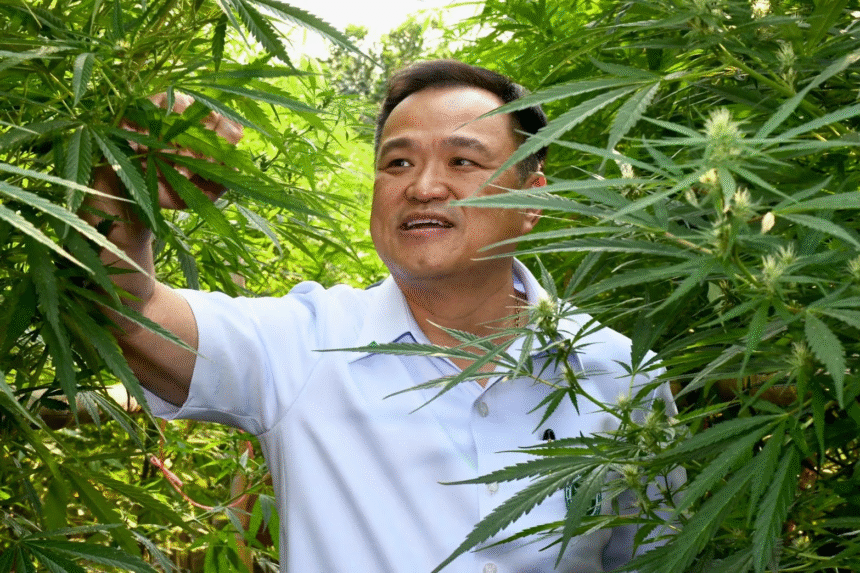
On 5 September 2025, Thailand entered a new chapter in its evolving cannabis policy: Anutin Charnvirakul, previously health minister and a long-time advocate of cannabis reform, was elected prime minister by parliament. Dubbed Thailand’s “cannabis king” by some observers, he leads the conservative, pro-royalist Bhumjaithai Party, yet his reputation for pushing decriminalisation of cannabis highlights how conservative values and cannabis reform are increasingly able to coexist.
While his government is transitional (he’ll dissolve parliament and call elections within four months), many in Thailand’s cannabis industry and among reform advocates are hopeful that legal clarity, regulatory stability, and a more balanced approach will return under his leadership.
From Anti Drug Hardline to Reform: Thailand’s Drug Policy History
Thailand has long had one of the stricter drug regimes in Asia. Some key points:
- Before reforms, cannabis (and other drugs) were tightly controlled under narcotics laws. Possession, cultivation, or sale could lead to heavy legal penalties.
- The country’s “war on drugs,” especially campaigns in the early 2000s under then Prime Minister Thaksin Shinawatra, were intense and often harsh, attracting international criticism for extrajudicial killings, human rights abuses, and aggressive policing.
- For many years, medical use was minimal, and public attitudes in many parts of government and society were conservative, viewing drug policy as a matter of law, morality and security more than health or economics.
Then came the shift:
- In December 2018, Thailand became the first country in Asia to legalise cannabis for medical purposes.
- In June 2022, under Anutin’s tenure as health minister, cannabis was decriminalised, removing cannabis and hemp from the narcotics list (for many uses), allowing broader cultivation, and spurring a boom of dispensaries, shops, and investment.
- But the reform was imperfect: regulations were vague (especially around sales, recreational vs medical, and prescription vs non prescription use), enforcement inconsistent, and concerns grew over youth use, unregulated shops, foreign tourists buying cannabis, and public health risks.
In 2024-2025, under the government of Prime Minister Srettha Thavisin and others, there was a move to roll back or tighten some aspects: banning non prescription sales, reclassifying cannabis buds as controlled, introducing stricter licensing and prescription requirements.
So Anutin returns to power today in a context of both promise and pushback. His past record shows a willingness to reform, and many believe he may ease or reverse some of the more restrictive elements introduced recently.
Who Is Anutin Charnvirakul: Conservative Values, Reformist Action
It’s worth emphasising the surprising alignment: Anutin is not a liberal progressive in all respects. He is a conservative royalist, leader of a party that is traditional in many ways, and has strong instincts toward stability, law, and order.
That he has championed cannabis reform (decriminalisation) while retaining respect among conservatives suggests that in some societies, policy reform on drugs doesn’t have to come from the left. It can be part of an economic agenda (agriculture, rural development), a health agenda (medical use), or even a justice agenda (reducing prison overcrowding, reducing illegal trade). Anutin has explicitly argued for those benefits.
Native Thai Landrace Strains and the Threat from Hybrids
One of the most precious parts of Thailand’s cannabis heritage is its native landrace sativa strains. These strains were cultivated over generations, adapted to local climate, soils, seasons, and cultural uses. Some of the most well known landrace sativas include:
- Squirrel Tail (also called Hang Kra Rok Phu Phan) — known for its bushy, long, stretching (sativa) habits and traditional flavor/aroma profile, often fruity.
- Chocolate Thai — a classic strain popular in the 1960s-70s with chocolatey, spicy, nutty flavors; it’s still prized as a heritage strain.
- Wild Thai (or Wild Thailand) — from places like Ko Chang or other islands; hardy, adapted to tropical humidity and heat, with distinctive flavors and terpene profiles.
These landrace strains are not just culturally important, they are genetically precious. Their rarer minor cannabinoids, terpenes, and environmental resilience make them valuable for therapeutic use, for breeding new strains, and for preserving biodiversity.
However, there is a real threat: as international hybrid genetics (from Europe, North America, etc.) pour in, plus commercial pressure, many landrace strains are being crossed with hybrids or replaced. Pure landrace phenotype preservation becomes harder. Also, long flowering times, lower yields, and sometimes lower stability make them less commercially attractive, unless regulated and valued.
Some Thai landraces have been officially recognized as national heritage strains by the Medicinal Plant Research Institute under Thailand’s Department of Medical Sciences / FDA, in order to promote research and conserve them.
Scientific Evidence & International Context: Why Legalisation Makes Sense
Thailand’s move is part of a broader global shift, supported by research showing multiple benefits of cannabis legalisation / de-criminalisation, when done well.
Some key findings:
- Studies (e.g. the “Analysis of the Benefits and Risks of Cannabis Legalization Policy in Thailand after 2022-2024”) show the legalisation in Thailand has generated jobs, boosted agricultural sectors, created tax/revenue opportunities, and provided medical benefits, though also pointing out risks around usage rates, regulation clarity, and youth exposure.
- Elsewhere, countries/states that legalised or decriminalised cannabis have seen benefits in reduced incarceration for minor possession, reduced policing resources spent, sometimes increased tax revenue, and often improved access for medical users.
- From a therapeutic point of view, there is growing evidence for cannabis (and components like CBD, THC, etc.) in managing chronic pain, neuropathic pain, nausea in chemotherapy, spasticity in MS, and in some mental health contexts (while being cautious about dosage, age, and risk).
- Research from Asia Pacific suggests that reform can also help reduce illicit trade, improve agricultural opportunities especially for remote or rural areas, and reduce negative consequences of criminal enforcement. (Thailand’s own reforms have been studied in that light.)
What Could This Mean for Thailand & Southeast Asia
With Anutin as PM, Thailand may restore some regulatory clarity, roll back overly restrictive rules, or at least push toward a stable framework that balances freedom, public health, and protection of vulnerable groups (youth, etc.).
Potential positive effects:
- Rural Farmers & Native Genetics: Landrace cultivators may benefit from more formal recognition, conservation support, and possibly preferential treatment in supply chains if heritage strains are valued.
- Medical Research: More certainty could allow universities, research institutes, and traditional medicine practitioners to better study landraces (which likely have unique minor cannabinoids and terpenes) for therapeutic uses.
- Tourism and International Trade: Thailand has long been a tourist destination; legal, regulated access (with respect for medical or recreational law) could bring responsible tourism, improve exports (if regulated), and help the economy.
- Regional Leadership: as one of the first Southeast Asian nations to move in this direction, Thailand could become a model for others exploring cannabis reform — e.g. Laos, Cambodia, Vietnam, Malaysia, etc. Conservative societies in the region may see that reform is not inherently liberal or disruptive of tradition.
Challenges & What Reformers Must Avoid / Watch
For reform to succeed, several potential pitfalls must be managed:
- Regulation clarity: prescription vs recreational sales, licensing, age limits, labeling, potency, testing, source control. Vague laws breed confusion and misuse.
- Protecting youth and vulnerable groups: ensuring that regulation prevents underage access, and provides education and harm reduction.
- Avoiding dominance by large foreign importers/hybrids: supporting small farmers and preserving heritage genetics.
- Balancing commercial opportunity with public health: managing smuggling, unlicensed sales, monitoring consumption patterns, ensuring medical claims are evidence based.
- Political stability: Given Thailand’s recent political volatility, sustaining policy reforms over successive governments is a challenge.
Conclusion: A Positive Turn with Broader Implications
Thailand’s election of Anutin Charnvirakul, a conservative leader with a record of cannabis reform, marks an important moment. It shows that in the 21st century, drug policy reform is not only possible in conservative political contexts, but that it can be embraced by them. The path toward legal, regulated cannabis (medical + limited recreational) offers multiple gains: economic, social, medical, cultural.
Preserving native landrace strains like Squirrel Tail, Chocolate Thai, and Wild Thai, protecting local farmers, and ensuring heritage genetics are not lost in the rush for hybrid potency, will be key symbolic and practical work. But the potential is real.
Other Southeast Asian countries are watching. If Thailand can demonstrate that legal cannabis, under sensible regulation, brings benefits without catastrophic social downsides, it could catalyze reform region-wide. For countries with strong agricultural bases, rich traditional botanical medicine, and economies seeking new sustainable crops, cannabis reform could offer a powerful opportunity.